Go to Ireland

NO STRANGERS HERE, JUST FRIENDS YOU HAVEN’T MET – William Butler Yeats
Visiting Ireland was one of our top bucket list destinations and the country did not disappoint. Rich in lore and vibrant traditions, Ireland is a gorgeous island of endless green, bordered by the striking coastlines of the North Atlantic Ocean and the Irish Sea.
A Brief History of Ireland
Ireland is a deeply historic island, with human settlements dating back nearly 10,000 years. Celtic tribes migrated to the region around the mid-1st millennium BC, forming the bedrock for many of the unique traditions, folklore, and the Gaelic language still utilized today. In the 5th century, the introduction of Christianity to the island became heavily attributed to the work of St. Patrick.
Later in the Middle Ages, devastating Viking raids eventually gave way to the establishment of permanent, fortified trading ports along the coast. Dublin, an area inhabited in various forms for millennia, was fortified as a permanent Norse settlement in 841 AD. However, the city’s official founding is celebrated as beginning in 988 AD, marking the year it was first taxed by the Irish High King, Mael Sechnaill II.
Following the Tudor conquest of the 16th century, Ireland came under direct English rule. This turbulent era of subjugation persisted until the early 20th century, when the brutal Irish War of Independence successfully led to the partition of the island and the birth of the Irish Free State. Today, the Republic of Ireland stands as a proud, independent nation and a vital member of the European Union.
Irish Ancestry Around the World
In researching my own roots, I uncovered some completely mind-blowing facts about the global Irish diaspora. Did you know that an estimated 80 to 100 million people worldwide claim Irish ancestry? I am incredibly proud to be one of them.
Between 1820 and 1957, four to six million Irish immigrants moved to the United States. They showed incredible courage. Because of this massive migration, the statistical chances are remarkably high that you share these roots, too.
In fact, over 10% of Americans claim Irish heritage. This creates a hilarious, upside-down reality. Vastly more people claim Irish ancestry globally than the entire actual population currently living on the island of Ireland.
May the Road Rise Up to Meet You
Flying to Ireland
Dublin has become a premier hub for trans-Atlantic air travel in Europe. Aer Lingus, the Irish flag carrier, operates out of numerous gateways across the United States. Nashville International Airport (BNA) recently added convenient connecting routes with them. After a brief layover in Philadelphia, we landed in Dublin in under seven hours. Because of its strategic location, Dublin serves as a perfect pivot destination. It offers easy short-haul flights deeper into the United Kingdom or onto mainland Europe.
Geopolitics of the Island
Geopolitically, the island of Ireland holds two separate nations. The sovereign Republic of Ireland occupies the vast majority of the landmass. Meanwhile, Northern Ireland encompasses roughly 17% of the island in the northeast. Northern Ireland is part of the United Kingdom. Thanks to the Common Travel Area, the two countries maintain a completely open border. This agreement allows for seamless travel between them.
Navigating the Roads
And yes—Ireland famously drives on the left side of the road. You might choose to rent a car. If you are unaccustomed to navigating the left-hand side, please exercise extreme caution. You must drive from the right side of the vehicle.
Personally, I am not that brave. We relied entirely on professional tour companies. They utilized spacious motorcoaches to visit areas outside of Dublin. For independent travelers, Ireland also boasts a sophisticated national rail network. This is called Iarnród Éireann. Convenient short-haul regional flights are also available.
Infrastructure & Footwear
Keep the scale of the infrastructure in mind. European cities evolved long before cars. Therefore, the streets are significantly narrower than American roads.
The major motorways are designated as “M” roads. These will feel very similar to interstate travel in the U.S. However, the lanes shrink considerably the moment you exit onto regional routes. This also happens when you enter local towns. While modern city centers feature standard asphalt, many historic districts still feature original cobblestone streets. These streets can be quite uneven. Be sure to pack sturdy, supportive footwear when planning your daily walking tours.
I WANT TO GIVE A PICTURE OF DUBLIN SO COMPLETE THAT IF THE CITY SUDDENLY DISAPPEARED FROM THE EARTH, IT COULD BE RECONSTRUCTED OUT OF MY BOOK. – James Joyce
Known worldwide for its literary giants and pints of Guinness, Dublin offers so much more. Dublin is ancient by age but incredibly young by population. As one of Europe’s premier high-tech hubs, Ireland’s capital and most populous city seamlessly blends its rich heritage with a vibrant, modern energy.
Right in the heart of the city center stands Trinity College, which houses the priceless, 9th-century Book of Kells inside its magnificent Old Library. Nearby, Dublin Castle sits proudly, tucked away amidst a patchwork of contemporary buildings as a striking reminder of the city’s medieval past.
Venturing slightly further out, you will find the world-famous Guinness Storehouse, where you can explore the multi-story history and production of Ireland’s finest and most iconic liquid export. A complimentary tasting is included with your tour, allowing you to head to the top-floor Gravity Bar, sit high above the rooftops, and sip a perfect pint while taking in a breathtaking, 360-degree view of the beautiful cityscape below.
IRELAND IS A LAND OF MYTH AND MAGIC, WHERE THE ANCIENT SPIRITS DANCE AMONG THE ROLLING GREEN HILLS. –W.B.
Growing up, one of my favorite movies to watch with my parents was The Quiet Man, starring John Wayne and Maureen O’Hara. Widely considered one of John Wayne’s best films, the story takes place in Ireland and follows an American boxer who returns to his ancestral homeland to rebuild his life after a career-ending tragedy. On screen, the background explodes with lush hues of green, brought vividly to life by the rich Technicolor of the 1950s.
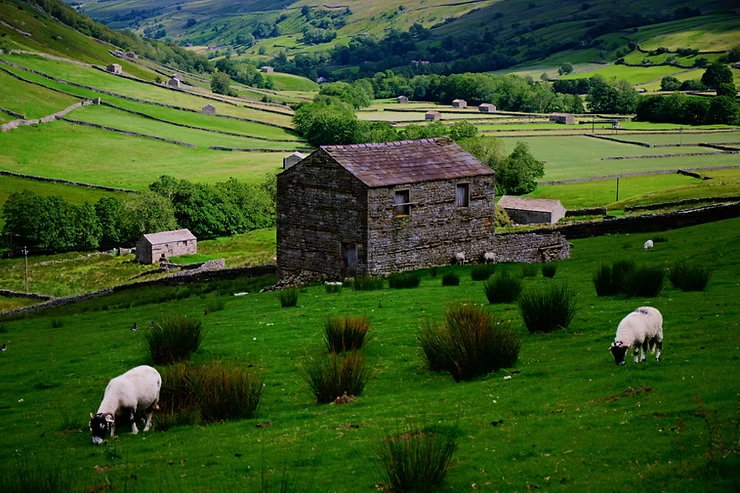
As a kid, I always had to ask myself: Is Ireland really that green? Having now seen it with my own eyes, I can tell you that yes—it is absolutely that green. In fact, even our best modern cinematic technology cannot fully capture the true vibrancy of the Irish countryside. Sweeping rolling hills dotted with splashes of fertile farmlands seamlessly decorate the landscape as far as the eye can see.
INCONCEIVABLE. –The Princess Bride, William Goldman
The real raw beauty of Ireland comes from its jagged coastline. This coast meets the turbulent North Atlantic.
Towering sprays of saltwater crash against the coast. This force sends a salty mist splattering across the sheer sandstone cliffs. The cliffs also consist of siltstone and shale.
While in Ireland, we took an unforgettable day trip from Dublin. We traveled across the country to Galway. Then, we went onward to the majestic Cliffs of Moher.
I first read The Princess Bride by William Goldman when I was twelve or thirteen years old. It remains one of my most treasured books. It is my ultimate comfort read during a reading slump.
The film adaptation is iconic. However, this is a rare case where the original book truly outshines the movie.
Goldman used the Cliffs of Moher as the direct visual inspiration for his famous “Cliffs of Insanity.” If you know, you know!
Catching my very first glimpse of the Cliffs of Moher made my heart pound. I instantly envisioned Fezzik scaling the ropes. The Man in Black was gaining ground right behind him.
The cliffs rise just shy of 400 feet above sea level at their southern end. They stretch up to over 700 feet at their highest point.
These cliffs stand as tall as a massive 35-to-70-story building. They drop straight down into the water.
Lush green grass blankets the terrain leading up to the very edge. Then, it abruptly drops off to the exposed, ancient rock below.
However, the Cliffs of Moher are only a fraction of the wild coastlines waiting to be explored. The world-famous Wild Atlantic Way encompasses 1,500 miles of the western coastline of Ireland.
It weaves past hidden beaches and dramatic headlands. It also passes colorful coastal towns.
The next time I go, I plan to dedicate significantly more time to the Wild Atlantic Way. It is one of the most beautifully raw sights on Earth.
Specifically, I want to spend time further south on the Dingle Peninsula. There, I can watch the wild landscapes meet the crashing Atlantic Ocean.
NO SUCH THING AS GIANTS. THEY’RE STORIES FOR THE CHILDREN. – Janos, Game of Thrones.
Ancient Gaelic lore tells a story of long-forgotten giants creating a massive stone pathway across the North Channel. According to legend, the Irish giant Fionn mac Cumhaill (Finn MacCool) was challenged to a fight by the fierce Scottish giant, Benandonner. Fionn’s clever wife, Oona, dressed her husband up as an infant, successfully convincing the arriving Benandonner that if the “baby” was already this terrifyingly massive, the father must be a truly colossal monster. Terrified, Benandonner retreated frantically back across the sea, ripping up the causeway behind him so Fionn could not give chase.
The slightly less magical, geological version of this story is that the Giant’s Causeway in Northern Ireland is yet another jaw-dropping example of how volcanic forces and the rough waters of the Atlantic shaped the Irish coastline. Approximately 50 to 60 million years ago, intense volcanic activity left deep fissures in the earth. As the thick plateau of molten basalt lava cooled rapidly and contracted, it cracked into roughly 40,000 interlocking rock columns stretching right into the sea.
These dark basalt columns are almost all a near-perfect hexagonal shape, creating a natural stepping-stone staircase where you can climb and walk just as the giants once did. In researching the site, I uncovered a deeply fascinating connection: directly across the North Channel on the Scottish island of Staffa, inside Fingal’s Cave, there is a small area featuring almost identical interlocking hexagonal columns! Did a giant really destroy the bridge? Sometimes, it’s just nice to believe that our timeless tales and traditions are far more than simple stories for children.
NEXT TIME I GO….
As I’ve already stated, my top priority for our next journey is to explore more of the wild western coast of Ireland, specifically focusing on the rugged Dingle Peninsula and the breathtaking Wild Atlantic Way.
While it is undeniably a major tourist hotspot, I think a dedicated stop to visit Blarney Castle in County Cork is a must-do tradition—if only for the pure sake of saying that I actually hung upside down and kissed the legendary Blarney Stone. Following that adventure, I want to spend real time exploring the city of Cork itself. It seems like a fantastic urban center, and it is widely reported to have one of the absolute best, most innovative culinary and food scenes in the entire country.
Ultimately, the most important factor for our next trip to Ireland will be pacing. I want to ensure we have significantly more time to simply slow down, stretch our legs, and walk throughout the countryside. By escaping the hurried windows of a rigid tour bus schedule, we can fully experience the timeless landscapes, charming local towns, and the wonderfully warm people of this beautiful nation.
Author
Europe Travel, International Travel, Ireland, Next Time I Go, Travel Experiences, Travel Tips