Go to Switzerland

The vibrant green plains stand against the Alps’ sharp, snowy angles. The contrast is breathtaking. Switzerland’s landscapes are as diverse as its inhabitants. Its rich history is interwoven with a modern patchwork of people and culture.
Located in west-central Europe, Switzerland is landlocked. It borders Italy, France, Austria, Germany, and Liechtenstein. The Jura Mountains cover the west and northwest before leading into the Swiss Plateau. Most of the territory then transitions into the Swiss Alps. They cover approximately 60% of Switzerland’s total land area. Most residents live along the Swiss Plateau, but the Alps are never far from view.
These snow-capped peaks and massive glaciers slowly melt into cascading waterfalls and rushing rivers. Two major European river systems originate in Switzerland: the Rhône and the Rhine. They traverse the landscape toward the Mediterranean Sea and the North Sea, respectively. Some of Europe’s largest lakes also dominate the terrain. The greatest is Lake Geneva, or Lac Léman, as it is known outside Geneva itself.
Languages and Culture in Switzerland
There are four official languages in Switzerland. The majority of the population speaks German, followed regionally by French, Italian, and Romansh. While not an official language, English is widely spoken, and most locals will comfortably switch to English when engaging with visitors.
Because of this geography, each area of Switzerland maintains strong cultural ties to its immediate neighbors. Geneva’s language, architecture, and cuisine are heavily influenced by France. After all, the French border is only 4 kilometers away. Near the German and Austrian borders, the local language shifts to Swiss-German. The culture and culinary staples also take on a distinctly Germanic character.
Ultimately, Switzerland is a true melting pot of cultures. Nearly 28% of its permanent residents come from other nations. This popularity has sparked intense political debate and proposed legislation on immigration. The goal is to balance population growth with preservation of Switzerland’s unique national identity.
History of Switzerland
From Ancient Settlements to the Swiss Confederation
The modern Swiss Confederation is relatively young. Historically, the region consisted of distinct cantons and city-states that eventually united. Traces of civilization date to the sixth millennium BC, including the Gächlingen settlement. During the Iron Age, Greek and Etruscan trade influenced local cultures. Growing Roman contact culminated in annexation by the Roman Empire during the 1st century BC.
Under Roman rule, the land and its settlements flourished until the empire declined. The Romans then abandoned Swiss cities, and Germanic tribes entered the territory. The lands were divided between the Burgundian and Alemanni kingdoms. They were later absorbed into the Frankish Empire under Clovis I. The Carolingian Empire divided the area into East and West Francia. Around 1000 AD, all of present-day Switzerland became part of the Holy Roman Empire.
In 1291, three alpine communities founded the Old Swiss Confederation as a defensive alliance. Together, they defied overreaching noble dynasties such as the House of Habsburg. In 1499, the Swiss defeated the Holy Roman Empire in the Swabian War. The victory established de facto independence.
Enter Napoleon
Napoleon invaded the region in 1798 and replaced the loose confederation with the centralized Helvetic Republic. His 1803 Act of Mediation restored the cantonal system. The Swiss then negotiated a precarious neutrality amid Europe’s wars. In 1815, the Congress of Vienna recognized and guaranteed permanent Swiss neutrality. It also expanded the nation to include Valais, Neuchâtel, and Geneva. Switzerland’s international borders have changed only slightly since then.
In 1848, the Swiss adopted a new federal constitution inspired by the United States Constitution. It balanced central federal authority with strong cantonal self-governance. In 1891, Switzerland revised this framework to incorporate elements of “direct democracy.” Citizens could challenge laws and propose constitutional amendments through a majority vote. Switzerland famously maintained strict armed neutrality through both world wars. This enduring position made Geneva a natural headquarters for the League of Nations. It later became the European headquarters of the United Nations. Switzerland is also celebrated as the birthplace of the Red Cross. Today, it hosts many international organizations, including the World Trade Organization, World Health Organization, and FIFA.
Planes, Trains, and Automobiles
Switzerland has seven international airports. Zurich, Geneva, and EuroAirport Basel-Mulhouse are the largest hubs. However, we chose a more cinematic arrival: the legendary Bernina Express from Northern Italy. This spectacular route carried us across the rugged Italian Alps. We traveled from Tirano, Italy, directly into the alpine paradise of St. Moritz, Switzerland.
After a brief stay in St. Moritz, we boarded the iconic Glacier Express. It carried us across the heart of the Swiss Alps to car-free Zermatt. From there, we could take a regional train or private transport to Geneva. After nearly two straight days on the tracks, we chose a private car transfer. We relaxed and watched the stunning countryside pass until we reached our final base. Geneva became the perfect pivot point for several incredible day trips throughout the region.
Experiencing this route gave me a profound appreciation for Swiss engineering. The Swiss excel at many things, but their transportation networks deserve special credit. These systems traverse intimidating terrain and mountains. When engineers confront a mountain range, they generally have three choices: go around, over, or through. Switzerland rarely wastes time going around. Instead, its infrastructure cuts straight through the granite.
The country boasts many breathtaking, high-altitude alpine roads. Still, its immaculate railway system is the crown jewel of Swiss transportation. The Glacier Express offers panoramic windows, while the Gornergrat Cog Railway climbs steep tracks. Both carry travelers effortlessly toward the world’s summits. Along the way, they provide unobstructed views of Europe’s highest peaks and deepest valleys.
With Great Beauty Comes Great Responsibility….and Costs
I am convinced that the most beautiful places on earth are proportional to how expensive it is to live or visit. Switzerland is no exception to that rule.
With Zurich and Geneva listed as two of the most expensive cities on the planet, part of that cost has to be associated with the beauty of the lands. That and the republic that Switzerland is, which maintains one of the best qualities of life for any country.Be mindful when planning your trip that the usual costs of hotels, tours, food, and the like will cost more than in other European nations.
Is the cost worth it? I think that’s a question for you to decide when planning your trip.
For us, the cost was worth it because we were able to see some of the most stunning landscapes of our life. We also planned a trip where we only spent one night in St. Moritz and Zermatt – both of which are playgrounds for the wealthy.
Longer stays would have been preferred, but I am glad we got a taste of the region rather than not seeing it at all.
Where We Went in Switzerland
St. Moritz and Zermatt
To manage our budget, we spent only one night each in St. Moritz and Zermatt. Both are legendary playgrounds for the wealthy. We would have preferred longer stays. Still, I am incredibly glad we sampled these regions instead of missing them entirely.
During this leg, the Bernina Express and Glacier Express served two purposes. They provided transportation between destinations and functioned as moving sightseeing platforms. My one regret is not having a full day to explore St. Moritz and Zermatt. We barely had time to get our bearings in St. Moritz.
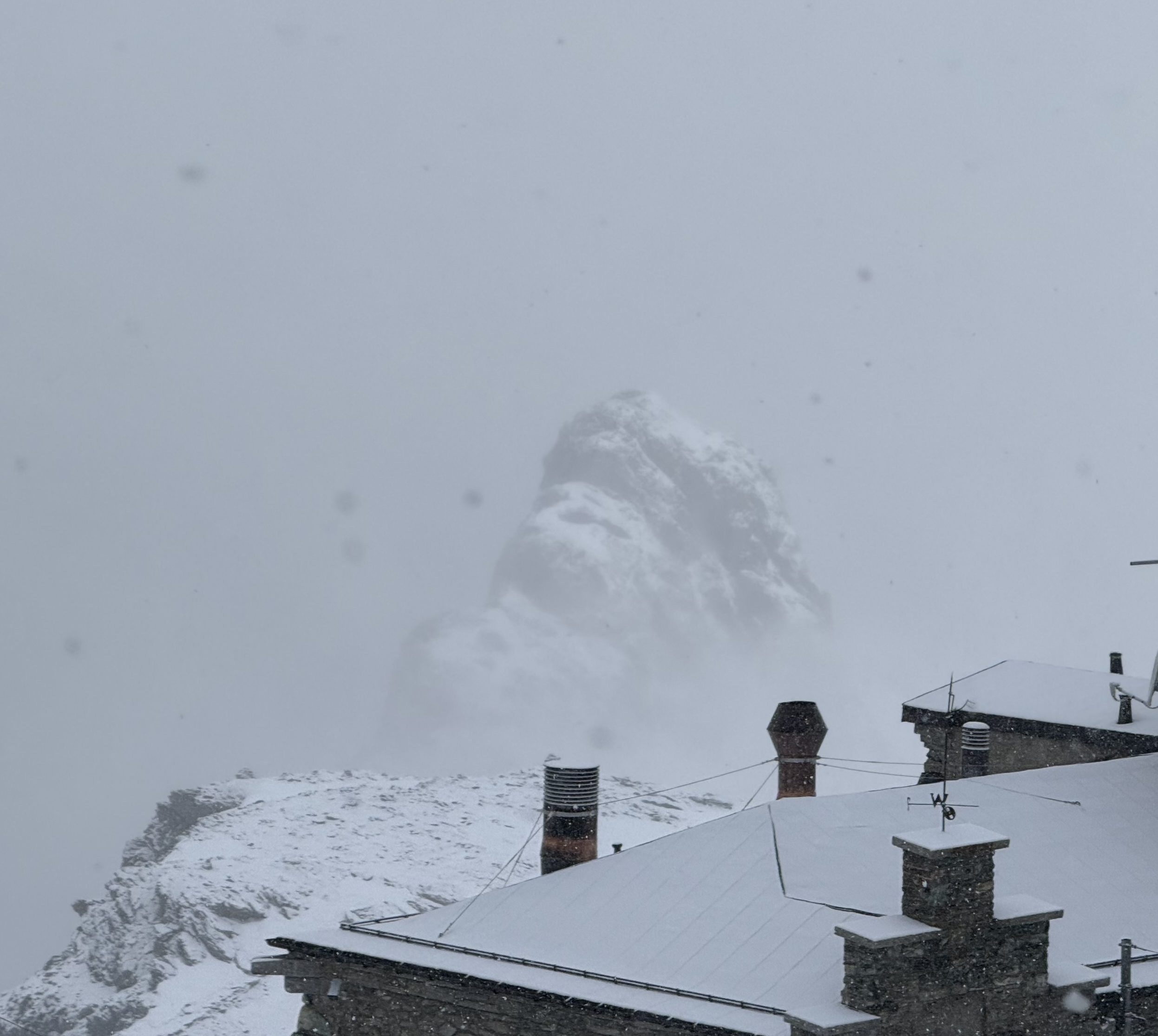
Our window in Zermatt was slightly longer, but we wanted more flexibility for our mountain excursion. Heavy snow turned our selected cog railway time slot into a complete whiteout. We only realized afterward that we had “seen” the Matterhorn. My camera captured its faint, ghostly outline hidden behind the storm.
Geneva
For Geneva itself, a three-day window is absolutely perfect. We spent our first full day exploring the city center and taking a guided tour. The city possesses a fascinating history and a complex diplomatic system that is well worth an explanation from an experienced local guide.
For our remaining time, Geneva served as an exceptional launching pad for unforgettable day trips.
Chamonix and Mont Blanc
During one of the days, we traveled across the French border to a town called Chamonix. The town itself was glorious and everything you could imagine an Alpine town to be.
At the base of Mont Blanc, you can take the Aiguille du Midi cable car up 12,000 feet to the summit of Mont Blanc. That cable car is not for the faint of heart if you have any reservations about heights.
I did not believe I had a fear of heights until I watched the almost vertical climb up the second stage to the top.
Would I do it again? Maybe not.
Am I glad I was brave and did it once? Absolutely.
Montreux and Chillon Castle
Also along Lake Geneva, we visited the town of Montreux, which sits at the foothills of the Alps. The city is famous for its architecture and jazz festival. It is also a pop culture draw, as Freddie Mercury spent his last years in this beautiful lakeside town.
There is also a medieval island castle, with its own moat to boot, called Chillon Castle. It is fun to explore with its well-preserved rooms, dungeons, and history.
Gruyères
Another daytrip led us to the Gruyères region, famous for its cheese and chocolates.
There is an actual town called Gruyères with a medieval castle at its heart. The town itself has cobblestone streets and one of the most breathtaking views we saw in all of Switzerland.
Next Time I Go….
Will there be a next time? Yes. Most definitely once my wallet financially recovers.
We saw a taste of Switzerland and cannot wait to dive deeper into the mountains and valleys. What would I do differently or in addition to what we already saw?
More Time in Zermatt and St. Moritz
I would like to have at least one full day in each to enjoy the towns and scenery.
Lauterbrunnen
The area is called the “Valley of 72 Waterfalls,” which says enough about my wish to view at least a few of those waterfalls decorating the landscape.
Interlaken and the Jungfrau Region
While I have no desire to experience the extreme sports the area is known for, I do want to explore the region.
I may not be an adrenaline junkie, but I’m a pretty-landscape-junkie, and pictures/videos of the area call to me.
Grindelwald
Have I mentioned how much I love alpine landscapes?
Lucerne
Another medieval town with historic landmarks and stunning views of the Alps. Need I say more?
Back to Geneva
I would also go back to Geneva in a heartbeat. The city is not only beautiful but also very safe and well maintained.
One thing we noticed about the whole of Switzerland is the care and pride the Swiss take in preserving the beauty of their country. While Swiss beauty may come at a price, the price is well spent with the security and high quality of living in this epic country.
Author
Europe Travel, International Travel, Next Time I Go, Switzerland, Travel Experiences, Travel Tips